Particle Systems Demo
An interactive 3D particle cloud simulation with fluid-like curl noise motion
About
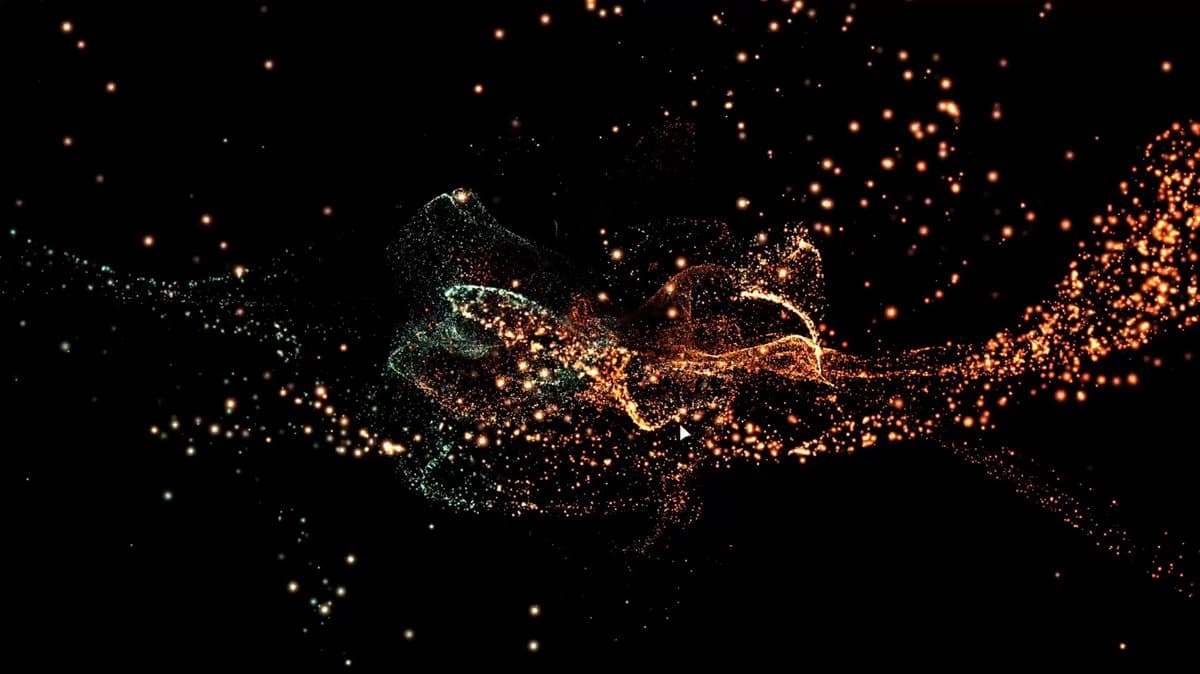
A high-density GPU particle system featuring tens of thousands of points that respond to interactive cursor forces. It utilizes curl noise to create organic, turbulence-based motion resembling smoke or nebulae, rendered with additive glow and depth cues.
Details
- Built with
- GLM-5.2NEWStrongpost says 'built with https://chat.z.ai/ GLM 5.2.'
The creator explicitly credits GLM 5.2 in the main post and provides technical details about the build process in the replies.
- Creator
- Source date
- Published on X Jun 25, 2026
- Listed
- Added to Dropday just now · model released Jun 16, 2026
- Evidence
- Strong
The author shared original video media, a prompt, and a screenshot of the parameter tuning interface in the discussion thread.
Prompt
I want to create a new experiment.

A dense cloud of tens of thousands of small particles suspended in 3D space against pure black. The particles render as soft white-to-grey points with light response — brighter where they face a virtual light source, dimming into shadow as they turn away, giving the cloud volume and depth rather than a flat scatter. Density varies naturally: tight luminous filaments and wispy tendrils in some regions, sparse dust drifting at the edges, so it reads like smoke, ink in water, or a nebula caught mid-bloom.

Motion.

Every particle is always moving. The base motion is curl noise (divergence-free flow) so particles swirl and fold through space like a fluid without ever clumping into dead pools or flying apart. Layer multiple octaves of noise at different scales and speeds: large slow swells that move the whole mass, mid-scale eddies that create the curling tendrils, and fine fast jitter that keeps the surface alive and grainy. The result should feel like turbulence — continuous, organic, never looping obviously, never mechanical.

Cursor interaction.

The cursor is a force in the field. As it moves it pushes particles outward (or pulls them in), carving channels and wakes through the cloud, with the disturbance easing back to rest after it passes so the motion always recovers smoothly. Velocity of the cursor could intensify the force.

Shape-forming.

Particles can be assigned target positions sampled from a 3D shape — a sphere, a cube, a torus, a model — and smoothly interpolate (ease) from their free-flowing state into that formation, holding it while still shimmering with noise on the surface, then dissolving back into open turbulence. Transitions between shapes should be fluid morphs, not snaps.

Aesthetic.

Monochrome, high contrast, weightless, slightly ethereal. The black should dominate; the particles are light emerging from dark. Subtle depth cues — particles further away dimmer and smaller, a faint additive glow where many overlap.
Technical note (optional): This is well-suited to a GPU particle system where position/velocity live in textures or buffers updated each frame in a shader (GPGPU / compute), since CPU-side updates won't scale to the particle counts needed for this density. Three.js with TSL (or raw WebGL/WebGPU compute) is a natural fit — curl noise in the simulation shader, additive blending, point sprites with a soft circular falloff, and a simple lambertian-style light term driven by the particle's local flow direction or a computed normal.

Please add relevant parameters to dialkit.
Timeline
Teaser
Video
Playable
Product
Loading…
Media & coverage
sourced from 1 post